
Pristine Devon river is in bottom 20% of river habitats
 The Otter should epitomise England’s ecologically rich and diverse river habitats. Unfortunately, the Middle and Lower sections of the River Otter and one of its key tributaries, the river Wolf Otter, are all classified by the Environment Agency (EA) as ‘Poor Ecological Status’. This places the River Otter in the worst 20% of the UK’s river systems, meaning significant impacts on plant life, wildlife and fish populations.
The EA identify the main pollutant types & key sources
- Sewage discharges coming from South West Water’s (SWW) sewage systems. In 2024, SWW released untreated sewage for 9,500 hours. This is 3x more untreated sewage hours into the River Otter than into Exmouth bay. EA also highlight pollution from ‘Agriculture and Land Management’, specifically livestock, soil and nutrient management
- High levels of phosphate cause algal blooms, eutrophication, and decreased oxygen levels in the water, leading to severe consequences for plant life, wildlife and fish populations. In addition, high concentrations of pathogens create a hazard for human and animal health.
To do something about this, the OVA formed ORCA - a campaigning group focused on working with local villages, farming communities, associations, government bodies and South West Water to restore the river Otter back to the healthy river it should be and also to ensure that the ecology of the river catchment is abundant and thriving to it's greatest potential. While sewage pollution if a major issue in the river, farming practices and historically constructed weirs are also an issue. We want to work with the farming community and associations like the WestCountry Rivers Trust to enable long-term change. We are also working with fishing associations such as the River Otter Fisheries Association to review structural issues within the river - such as effective weir management.
EDDC published the long-awaited "Water cycle report" that showcases the state of the water service for SWW in Devon. You can view it [ here ].
Our focus will take a number of different aspects:
- A testing program to look at water quality along the river Otter [ CLICK HERE ]
- Ongoing data analysis to ensure everyone has the facts relating to water quality along the river Otter
- Awareness building into the community to ensure everyone is aware of the issues facing people and nature in the catchment of the river Otter
- Campaigning to enable change (farming, house building, South West Water, Weir management, etc).
We welcome any input into our plans and of course any expressions of interest to join our group of water testers. Our goal is that by 2028 the ecological status of all sections of the river Otter should be classified ‘moderate’ or ideally ‘good’.
Community Monitoring Update
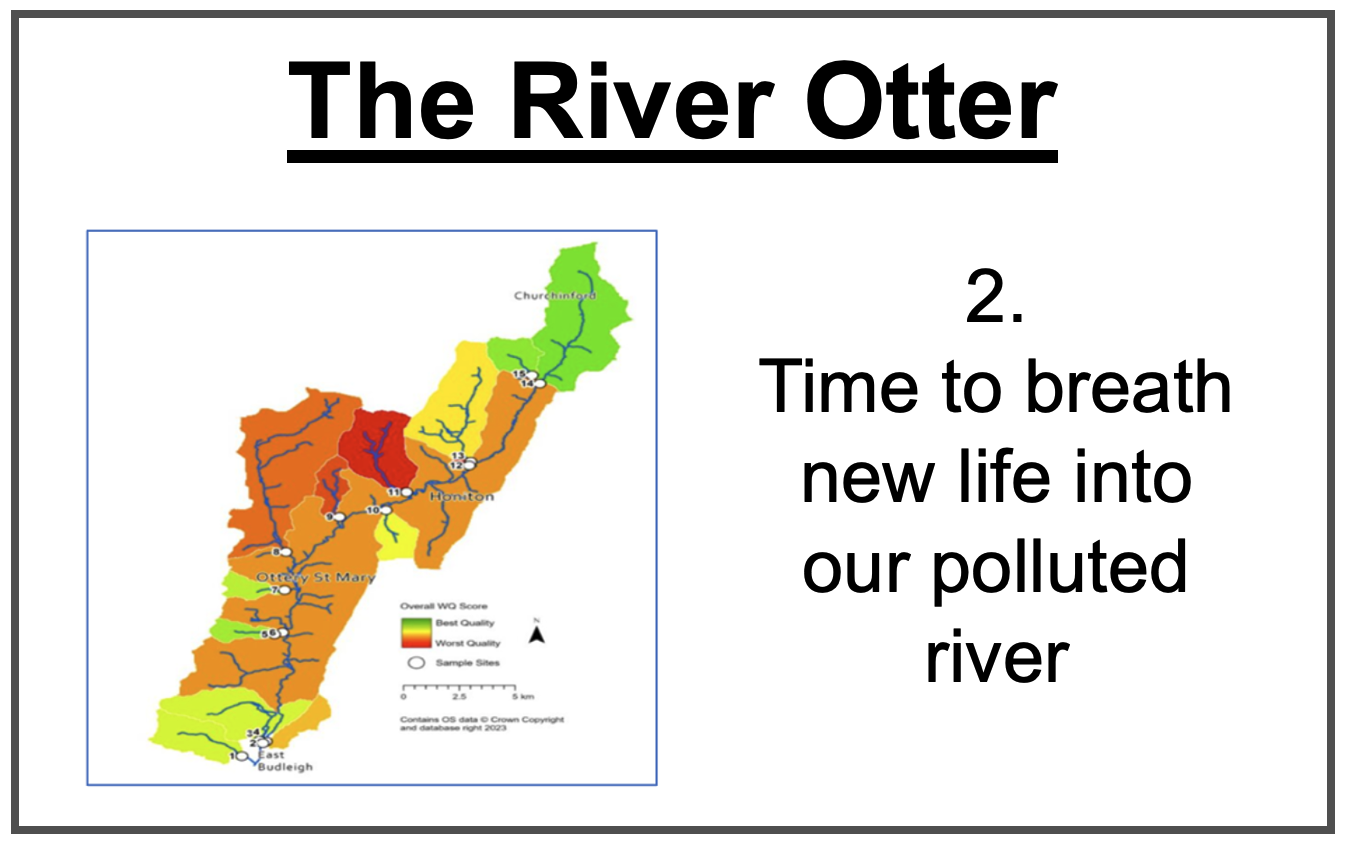
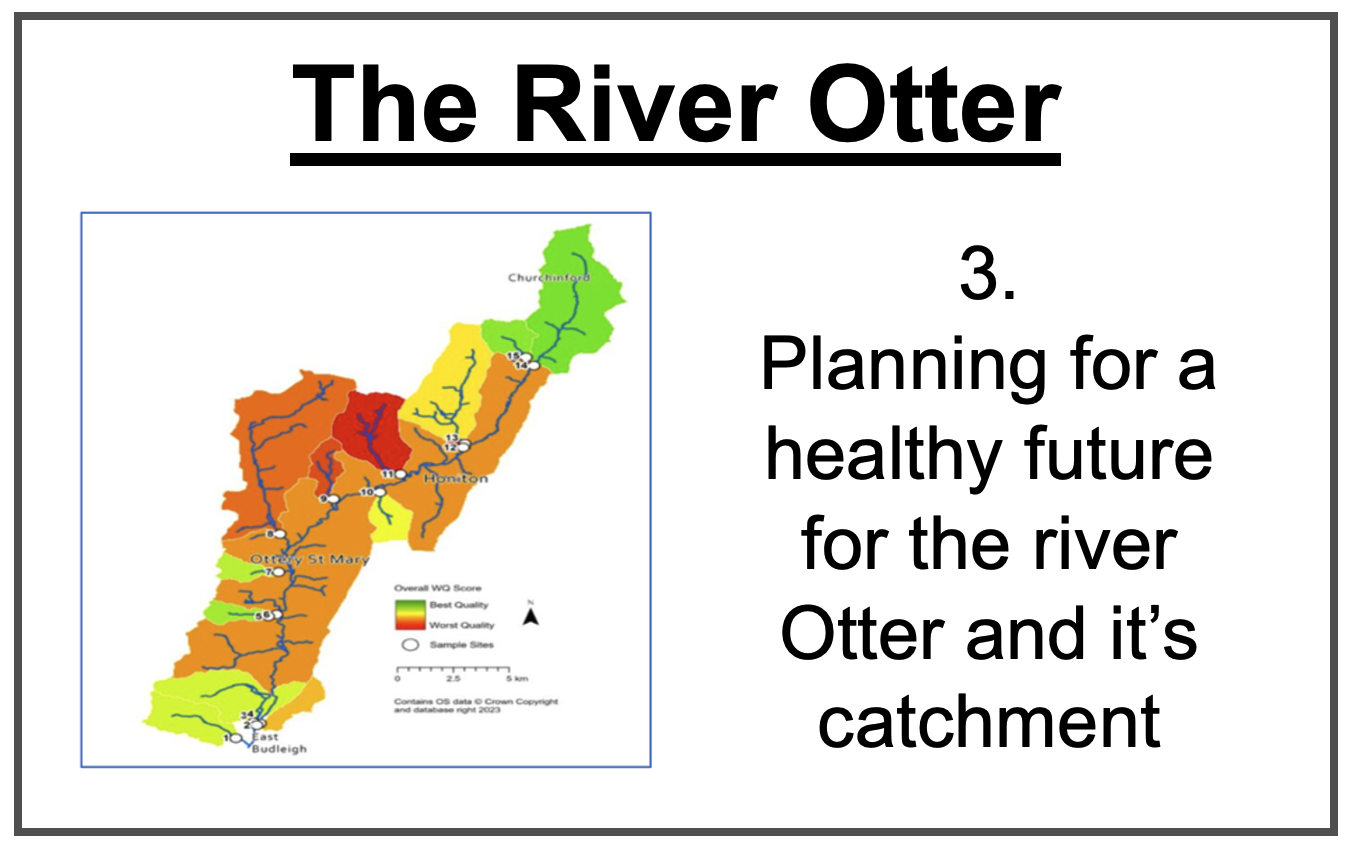
Over 50 local ORCA volunteers have been testing 12 locations affecting the Otter catchment, every two weeks since the end of March 2025. This program provides by far the largest dataset on River Otter water quality. The first nine months (18 test cycles) has revealed that Phosphate pollution is the river’s most serious problem.
The ORCA campaign is based on the insight derived from this data, and without the dedication of all our testers, none of this would be possible. Here is a brief summary of our progress to-date:
- ORCA test data shows phosphate levels above safe level, and doubling below Honiton sewage works. Approx 70% of the Middle and Lower Otter’s total phosphate is from sewage works treated effluent.
- Clear evidence of environmental harm captured by ORCA test teams
- In series of joint meetings with OVA/ORCA and Richard Foord MP, South West Water (SWW) finally committed to a limited program of improvements to reduce untreated sewage discharges - but only after public outcry. Far more action required.
- CEO Susan Davy publicly commits SWW to "reduce untreated discharges to no more than 20pa average", and "to reduce phosphate in treated effluent", by 2030. However, SWW also confirmed that they have NO current schemes to remove any Phosphorous from treated effluent by 2030. OVA/ORCA will hold SWW to their public commitments.
- Honiton treatment works, the source of half the phosphate from all sewage works, has been in breach of its permit condition on phosphate for three of the last six months.
- SWW state that a Phosphate reduction scheme had been proposed for Honiton STW, which would have removed 35% of all SWW-sourced Phosphate before 2030, “but in discussion with the Environment Agency it had been removed from 2025-2030 plan”
- EDDC commissioned a ‘Water Cycle Study’ that shows Honiton treatment works (largest on the river) is already operating at 40% above capacity – which is why so many discharges into the river occur. This is projected to rise to 73% over capacity when future building plans are taken into account.
- Chair of EDDC’s Strategic Planning Committee commits to reject further planning applications in Honiton "until SWW deliver sufficient treatment capacity".
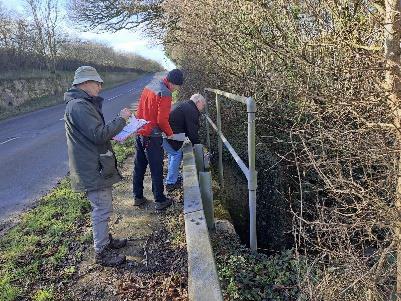 | 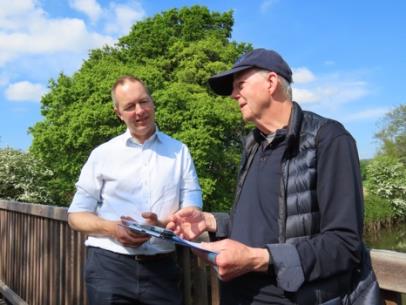 |
Volunteers from the ORCA team testing water quality on the River Otter | Richard Foord (MP) and Peter Williams (ORCA team) testing water quality on the River Otter |
River Otter Testing, Analysis & Engagement
Our ORCA team have now been testing the river Otter every 2 weeks for over one year. Here we review what 15 years of Environment Agency sampling tells us about phosphate levels at one point in the lower Otter, and take a look at South West Water’s own data showing very high levels of E.coli in the river Otter. Meanwhile our ORCA team have provided a public update of their results to audiences in Budleigh Salterton, Ottery St Mary and Colaton Raleigh.

Why not join in and add your voice?
To get involved in this campaign and show your support, just use this QR code and signup. Why not also join in the conversation by joining the ORCA Facebook group – which has just exceeded 500 active supporters!
One full year of Community Monitoring
We set up the ORCA campaigning group about 18 months ago with a call for volunteers. Following the recruitment process, these volunteers were all trained, risk assessments were published and the OVA provided relevant insurance for the testers to operate. Since then we have now completed a full year of 24 completed test cycles by 54 accredited testers performing 288 location tests, on 13 sunny days, 11 rainy days, 3 floods … consuming 620 sandwiches, 74 cream teas and 82 beers! Over 2,880 individual tests and observations have been logged. For this, we would like to extend a huge thank you to our amazing team of volunteers.
This testing is the most comprehensive testing performed on the river Otter – to put this in perspective, the Environment Agency carried out just 24 location tests on the River Otter in the same period.
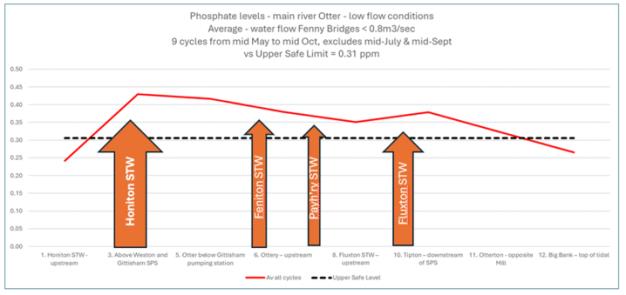
Our results show that phosphate levels rise to alarming levels just south of the main Honiton Sewage works, and remain high all the way down the river as more sewage effluent is pumped into the river at subsequent treatment works and pumping stations, only dropping below the Environment Agency’s “Upper Safe Level” below Otterton.
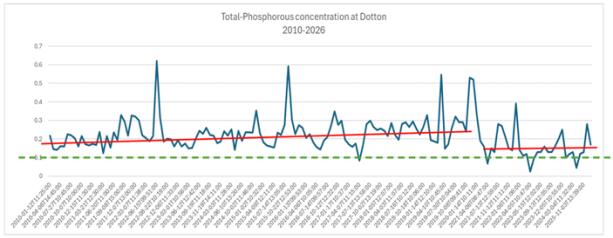
As well as analysing our own ORCA data, we also review all other river data sets produced by the Environment Agency, South West Water and other conservation groups. Although the Environment Agency only sample at a few spots in the catchment, the one benefit of their data is that we can analyse phosphate levels at Dotton, a few miles south of Newton Poppleford, once per month over the past 15 years.
Using this data set, we can make a number of important observations:
- The general trend from 2010 to 2020 is a very high and gradually increasing phosphorous concentration in the River Otter, where the increase appears to correlate with the local population increase in the catchment
- Phosphorous level at Dotton then drops significantly in March 2020. This drop coincides with some basic phosphate removal work being completed at Honiton, but more importantly it’s the date when a state-of-the-art phosphate-removal scheme went live at Fluxton sewage works. As Dotton is about four miles downstream of Fluxton sewage works, we see the full impact of this local reduction.
- This significant drop demonstrates that Phosphate-reduction projects at sewage works, of the type we are calling for, really do make a material difference to total phosphate levels in the river
- It also indicates that a similar reduction from sewage works in future, particularly at Honiton and Feniton, would likely produce a similar step-change improvement in measured phosphate levels downstream
- Unfortunately, the chart then shows a slow background increase in phosphate levels from 2020 through to 2026, again likely reflecting increased wastewater from population growth
- It’s clear from the chart that NO other factors appear to have impacted phosphate levels at Dotton, in any way that exceeds the background increase in phosphate through population growth. This includes all agriculture regulatory and advisory work by EA, Westcountry Rivers Trust and Devon Wildlife Trust, which have received £millions in investment. Whilst this work has reportedly reduced phosphate levels in the upper reaches of the Otter and in several of the tributaries, it does not appear to have any impact on net phosphate levels in the lower river.
- That certainly does not mean however that this agriculture advisory work has not delivered important ecological benefits. Key focus areas include reducing soil run-off, stopping livestock from dumping their waste directly in the river, and advising on proper storage of farm waste - which reduces the potential for catastrophic fish kills from slurry. All of this work is very important in creating a rich river environment for the benefit of wildlife and people
- The lack of any apparent reduction in agriculture-derived phosphate levels at Dotton though, given its success elsewhere in the catchment and on other neighbouring rivers such as the Axe, provides important evidence that the majority of the phosphate in the lower Otter is sewage derived.
Concerning E.coli levels in the river Otter
Our ORCA team have been testing a wide range of indicators of river quality, and based on those samples plus observations of the river ecology, phosphate appears to be the most important element affecting the environmental health of the river. However, given that the primary source of phosphate is sewage works, and the very high levels of untreated sewage discharges dumped into the river Otter, we were also interested to see what the E.coli levels in the river Otter have been.
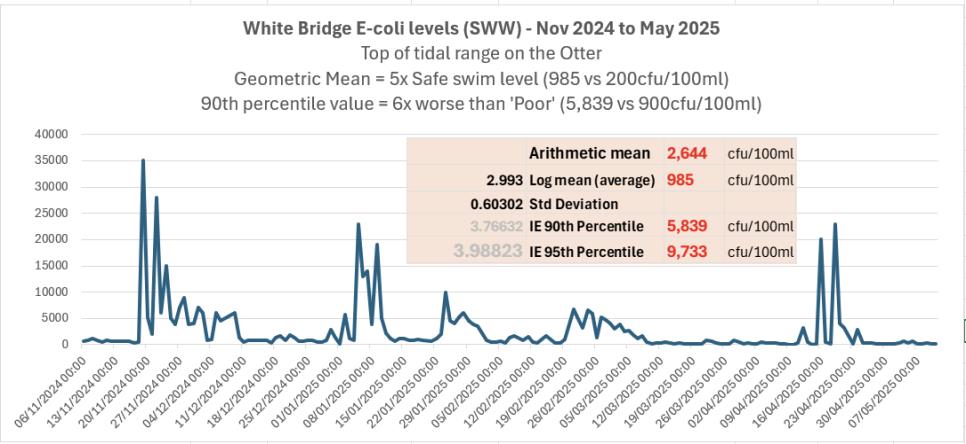
As you can see, the E.coli levels are higher than the generally accepted ‘Safe Swim Level’ (dotted red line) on 90% of days during that period, with the average E.coli reading being five times the ‘Safe’ level.
High levels of E.coli come down the River Otter, particularly after even very slight rainfall in the catchment. Sources are livestock agriculture and untreated sewage discharges, of which there were over 8,000 hours in 2025. Whilst not included in the ecological health classification, high concentrations of these entero-bacteria create a hazard for human and animal health.
Following the loss of Budleigh’s Blue Flag beach status in 2025 due to high levels of entero-bacteria, South West Water stated publicly that the E.coli levels at Budleigh’s beach ‘could be caused by birdlife in the new Otter Nature Reserve’.
To see if that could be the case, we analysed the same SWW dataset to compare the E.coli levels at White Bridge (so above the Nature Reserve), with the daily readings at Otter mouth, which carries the River Otter plus outfall from the Nature Reserve tidal lagoon out to the sea, and from there to our beach.
The Otter mouth samples show ALL E.coli peaks coincide with levels coming down the Otter at White Bridge. Therefore, high E.coli readings at Otter Mouth do NOT appear to come from bird life or other factors in nature reserve.
In fact, the evidence shows that the nature
reserve is a recipient of the
River Otter's entero-bacteria pollution,
NOT a significant source for increased E.coli.
We were delighted to have been approached recently by Plastic Free Budleigh to help them in a water testing program in Budleigh Bay. They had been contacted by a team called “Bugwatch” led by Dr Jonathan Cox from Aston University and the Microbiology Society. They are looking to test the water quality at Blue Flag beaches for 7 consecutive days over the Easter period.
As you all know, Budleigh lost its blue flag last year! The team were very happy for us to be involved (for which we say thank you !). So, we asked our ORCA water testers if any of them would be interested in helping out. While this is not exactly on the river, it is testing where the river Otter hits the beach. We were delighted when the team responded in the affirmative. So, we undertook 7 continuous days of testing on the beach near the mouth of the river Otter. This data will be part of a published case study which we will share in due course.
We are now looking at how we can add E.coli testing to the river at selected locations alongside our current chemical testing. To do this we need to invest in new testing equipment and the relevant reagents that are used during each test. We will share more of this testing in future issues of “Otter Life” and via Facebook / web.
Collaborating with the EA
Our ORCA team continue to work with Richard Foord, MP, and the River Otter Fisheries Association (ROFA) to engage with both South West Water (SWW) and the Environment Agency (EA). Our latest meeting was a positive and engaging meeting with Richard Foord, ROFA and the EA in order to review all of the data sets relating to phosphate attribution data, ie: apportion where the phosphate in the river comes from. This is important as the Environment Agency use this attribution data to ‘inform where action is most needed and support investment decisions aimed at improving water quality’.
OVA/ROFA’s analysis suggests that sewage works remain the primary source of phosphorous in the Lower Otter, and supports the data published by the EA in 2024.
Our requests from the Environment Agency:
- A further meeting with EA’s technical team to review EA and ORCA detailed data sets with EA staff in relation to the attribution models, and confirm an attribution model which aligns with measured Phosphate data and timeline of known changes to sewage system.
- We are asking EA to review the operation and permit for Honiton STW in light of environmental harm being caused to a river which is already classified as being ‘at risk due to phosphate’, plus East Devon District Council’s damning Water Cycle Study and Honiton’s sewage treatment capacity vs demand today and after a planned 980-home increases. These are just some of the many issues currently affecting Honiton STW. We are asking EA to consider placing a requirement for increased treatment capacity and a state-of-the-art Phosphorous removal scheme and permit.
- To improve the Feniton STW upgrade which is due in 2030. SWW state that the primary objective is Nitrogen removal, rather than Phosphate. During our discussions with EA, it seems that this upgrade will also now include a (new?) minor form of phosphate removal. However, in view of the clear evidence of environmental harm in the river due to high phosphate levels, we are asking that consideration be given to an amendment to the permit, such that it requires a high-level of phosphate removal, similar to that which has been highly successful at Fluxton.
- Request that EA add a regular sampling point to the Middle Otter section, somewhere just downstream of Honiton STW. Currently EA have no routine visibility of water quality in the middle or lower Otter, until the sampling point at Dotton.
Campaign to#ReviveTheRiverOtter | Community SupportGrows for the River | Coveragein press & online |
 |  |  |
Published Articles of Interest:
The ORCA team have published, and will continue to publish, articles of interest concerning the state of the river.
 |  |  |
 | .png) |  |
 | .png) |  |